
Top Signs You Need Garage Door Service – Don’t Ignore These
Most garage door failures announce themselves weeks before they strand a car. The signs are rarely subtle, but they’re easy to explain away with four words: “it still works.” A door that takes three seconds longer to open than it did last month isn’t aging gracefully. Its torsion springs are losing tension at a measurable rate, and the opener is pulling harder to make up the difference. That extra strain has a cost, and it gets paid by the springs, the cables, or the opener motor.
Here’s what each warning sign actually means, why it happens, and how to tell a normal quirk from a failure already in motion in Cherry Hill. If you’d rather not figure it out alone, call (833) 508-9337.
Your Door Is Slower Than It Used to Be
A slower door almost always points to spring tension loss, not old age. Torsion springs are sized to match your door’s weight: wire diameter and coil count determine how much lift they can deliver, and that capacity drops with every cycle. Most springs are built for a set number of cycles, and once they pass it, the metal fatigues gradually. The door gets heavier to lift, the springs deliver less force, and the opener covers the gap with torque it wasn’t designed to sustain. That’s not a quirk. That’s a failure sequence, and it usually ends with a snapped spring or a burned-out opener gear.
Here’s what’s worth checking:
- Compare today to a month ago. If the door now takes noticeably longer to rise, spring tension has changed at some measurable rate.
- Listen for the opener straining. A motor that sounds labored on the climb is compensating for springs that have lost lift capacity.
- Watch for hesitation mid-travel. A door that stalls slightly around halfway up, then catches, is fighting its own weight.
Age alone doesn’t predict this. Cycle count does, which is why a regularly used door in Cherry Hill can wear out its springs long before a door that sits idle most of the week. Our technicians have up to 12 years of experience reading exactly this kind of wear, and we’ll tell you plainly whether garage door spring repair solves it or whether something else is behind the slowdown.
Unusual Sounds and What They Actually Mean
A noisy door is a door telling you where the problem is. Each sound maps to a specific component, and knowing the difference helps you describe it when you call, which saves diagnostic time. Grinding, popping, and rattling are the three most common complaints we hear, and none of them mean the same thing.
- Grinding usually comes from worn rollers or a failing opener motor gear. Rollers flatten and lose their bearings over time; a stripped gear inside the opener grinds against its housing.
- Popping typically signals coil binding in a spring under uneven tension, or a cable jumping its drum. This one deserves prompt attention, since a spring under load can fail without warning.
- Rattling means loose hardware somewhere in the system: hinges, bolts, or brackets that have worked themselves free. Loose parts can drop into the track and become an obstruction that stops the door cold.
If your opener is a LiftMaster or Chamberlain and it grinds on every cycle, the motor gear is the first place a trained eye looks. On a Genie or Craftsman unit, that same sound often traces back to a worn drive assembly instead. Same symptom, different cause, which is exactly why a garage door specialist reads the sound before quoting the fix.
The 10-Second Cable Check That Predicts Trouble
Cable failure isn’t random. Frayed strands near the bottom bracket show up weeks before a cable lets go, and the whole check takes about ten seconds. Stand to the side, not underneath the door, and look at where each cable meets the bottom corner bracket. A healthy cable is smooth and evenly wound. A cable in trouble shows individual wire strands separating, a kink, or a frayed section right at the bracket.
Fraying at that spot isn’t bad luck. The bottom bracket is where the cable takes its sharpest bend and carries the most load, so that’s where fatigue shows first. Cables and springs are both high-tension components, and this is not a DIY repair. A cable under load can cut through a hand or whip loose when it snaps. What you’re doing here is looking, understanding what you see, and calling before it fails.
We handle that safely as part of routine garage door repair, and we’ll tell you honestly whether you need a cable swap or a fuller tune-up. If a cable is visibly frayed in Cherry Hill, treat the door as out of service until someone trained looks at it.
A Door That’s Off-Level Is Telling You Something
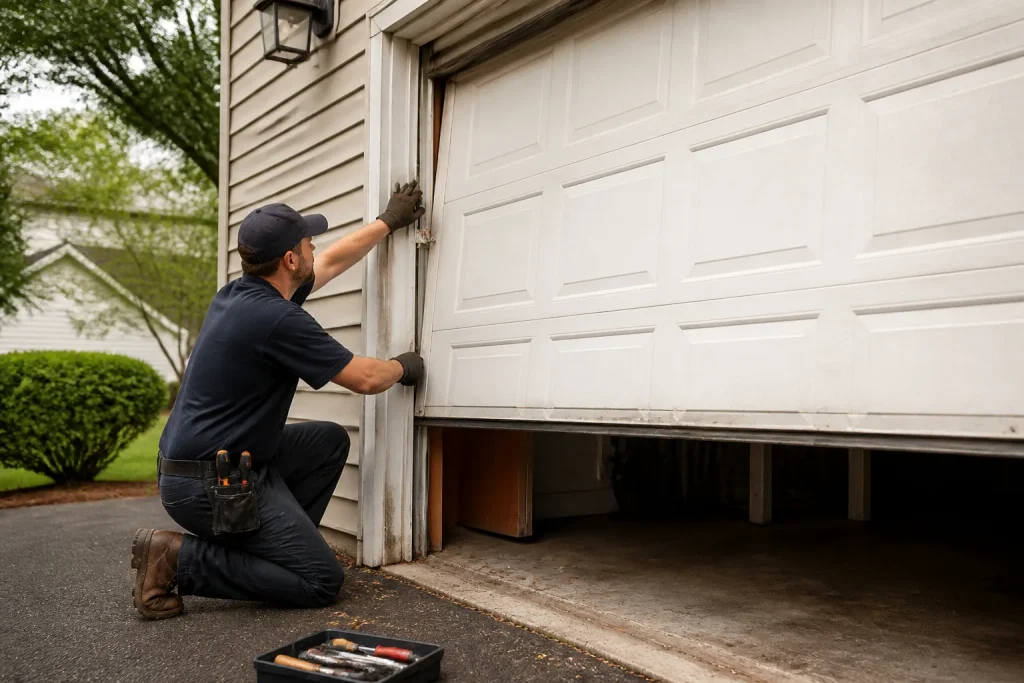
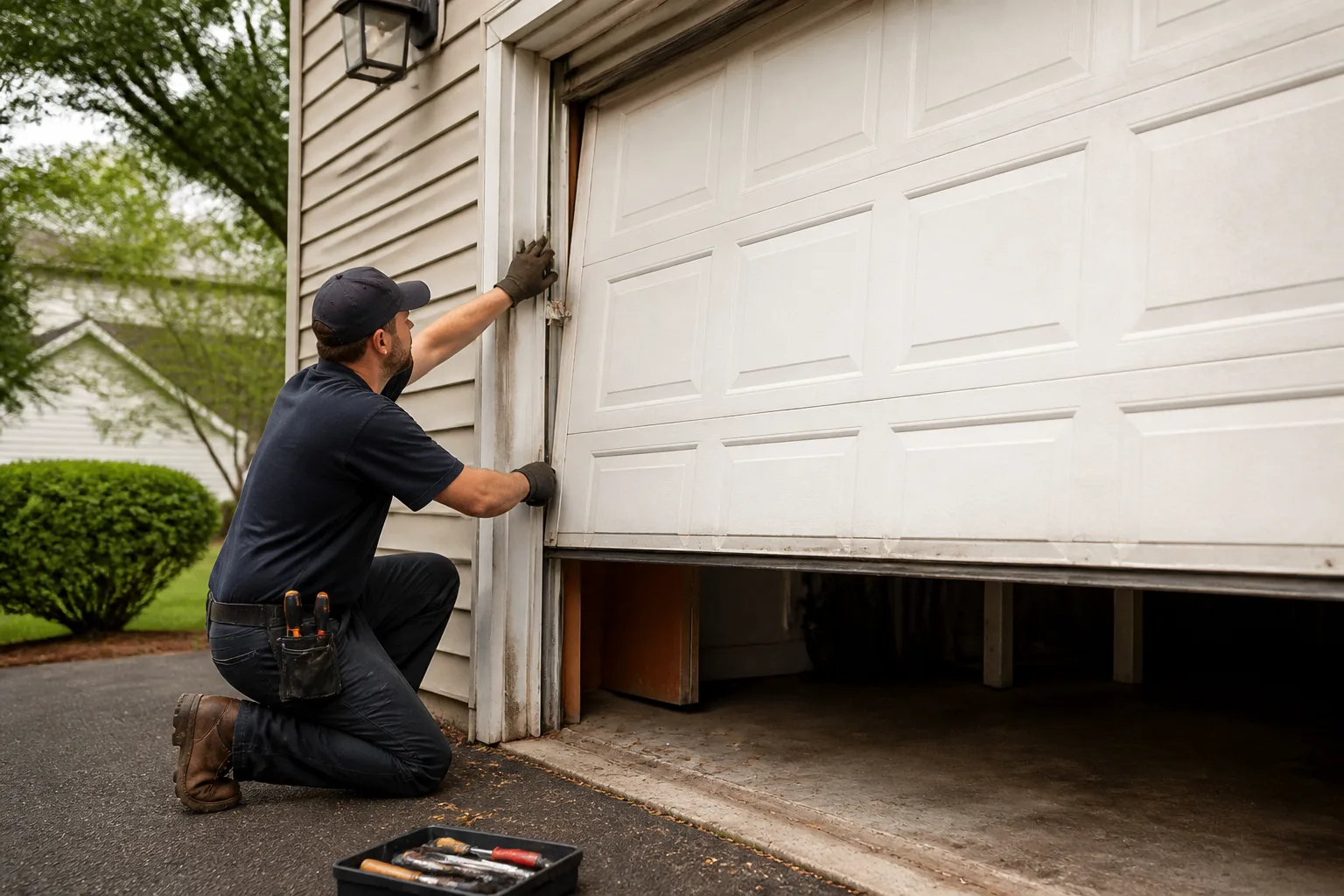
One side visibly higher than the other looks cosmetic. It isn’t. An off-level door usually means one spring is carrying more load than the other, so the two sides lift at different rates. That imbalance pushes and pulls at everything attached to the door: rollers twist in their hinges, the track wears unevenly, and the opener fights a door that’s dragging on one side. Left alone, the heavier-loaded spring fatigues faster and fails first, and the uneven track turns into a jam.
What to look for:
- A visible gap at one corner when the door is fully closed, with the other side sitting flush.
- Uneven travel: one side reaching the top edge before the other.
- Daylight showing unevenly along the bottom seal from inside the garage.
An off-level door on a Clopay or Amarr sectional is a common call we get in Cherry Hill, and rebalancing it is often a spring and track adjustment rather than a replacement. Ignore it long enough and the track itself bends out of true, which is when the cheap fix becomes a bigger one.
The Monthly Balance Test That Catches Most Problems Early
Pull the opener’s release handle, lift the door by hand to about halfway, and let go. A properly balanced door holds its position or drifts only slightly. If it drops fast or won’t sit still, a spring or cable is failing. If it’s very hard to lift by hand, spring tension is low and the opener is doing work it shouldn’t. Run this test once a month and you’ll catch the large majority of developing problems before they turn into an emergency: a car trapped inside, a door stuck open, or a snapped spring. We’ve seen it save plenty of Cherry Hill homeowners a stressed morning, and the test costs nothing but a minute.
Beyond the balance test, a quick visual pass pays off: check the cables, look at the rollers for flat spots, and make sure the safety sensors at the floor are aligned and clear. None of this requires touching springs, cables, or the opener’s internal parts, and skipping the closer look is how small issues grow.
When to Call a Pro
Call us when the door hesitates, when you hear popping or grinding, when a cable looks frayed, or when the door sits off-level. Springs and cables carry real tension and can cause serious injury when handled incorrectly, so this isn’t the place for a homeowner’s repair attempt. A trained technician can read the whole system, from the opener motor through the springs, cables, and track, and tell you whether repair makes sense or whether replacement is the honest answer. We work on the brand you already own, whether that’s a LiftMaster opener, a Genie unit, or a Clopay or Amarr door, and we’ll say plainly which option fits. Our estimate is free and the price is set per job before any work starts. Call (833) 508-9337. We answer 24/7. Fast dispatch from 7am to 7pm, Sunday through Friday.
Related services in Cherry Hill: for a door that’s slow but not broken, garage door opener repair often addresses the root cause. For a door beyond repair, Garage Door Repair Cherry Hill covers full installation as well as repair.
The Bottom Line
A garage door failing is a sequence, not a surprise. Slower operation means spring tension is dropping and the opener is straining to compensate. Grinding, popping, and rattling each point at a specific part wearing down. A frayed cable and an off-level door are both predictable warnings, and the monthly balance test is the cheapest check you can run. Every one of these signs is a mechanical event already underway. The worst move is telling yourself “it still works” and coming home to a door that won’t budge. If you’re in Cherry Hill and need help, Garage Door Repair Cherry Hill offers free estimates: call (833) 508-9337.
Frequently Asked Questions
The most common early signs are a door that opens slower than it used to, grinding or popping sounds, a frayed cable near the bottom bracket, and a door that closes off-level. Any one of these points to a mechanical problem in progress, not a cosmetic quirk. Call (833) 508-9337 for an exact quote; estimates are free.
No. Springs and cables are high-tension components, and this is not a DIY repair. They can cause serious injury if handled incorrectly, which is why trained technicians handle them. We’ll handle it safely and tell you exactly what’s wrong. Call (833) 508-9337.
Run the manual balance test once a month and do a quick visual look at the cables, rollers, and sensors. That routine catches most developing problems early. If something looks off in Cherry Hill, call (833) 508-9337 for a free estimate before it turns into an emergency.
Not always, but it should be checked soon. An off-level door usually means one spring is carrying more load than the other, which wears the rollers, track, and opener faster over time. Don’t wait for it to jam. Call (833) 508-9337. We answer 24/7. Fast dispatch from 7am to 7pm, Sunday through Friday.
Written by the team at Garage Door Repair Cherry Hill.
Need Garage Door Help?
Call Garage Door Repair Cherry Hill - the local pro we connect you with is licensed and insured, here with fast help in Cherry Hill.
(833) 508-9337